

Why Your Brand Message Is Costing You Clients
Why Your Brand Message Is Costing You Clients
Before you write a single word of content, build a strategy, or redesign your website, one thing must come first: a clear, resonant message.
You have 15 years of experience and a website that sounds like everyone else's in your field. You are excellent at what you do. And yet, when it is time to talk about what you do and who you serve, the words feel slippery. Your website does not capture it. Your emails do not land. Your sales conversations wander.
The problem is almost never your expertise.
The problem is your message.
"Your message is the root of everything you create. If it is not clear and aligned to your audience, nothing else you build will resonate."
Why Your Message Is the Root of Everything
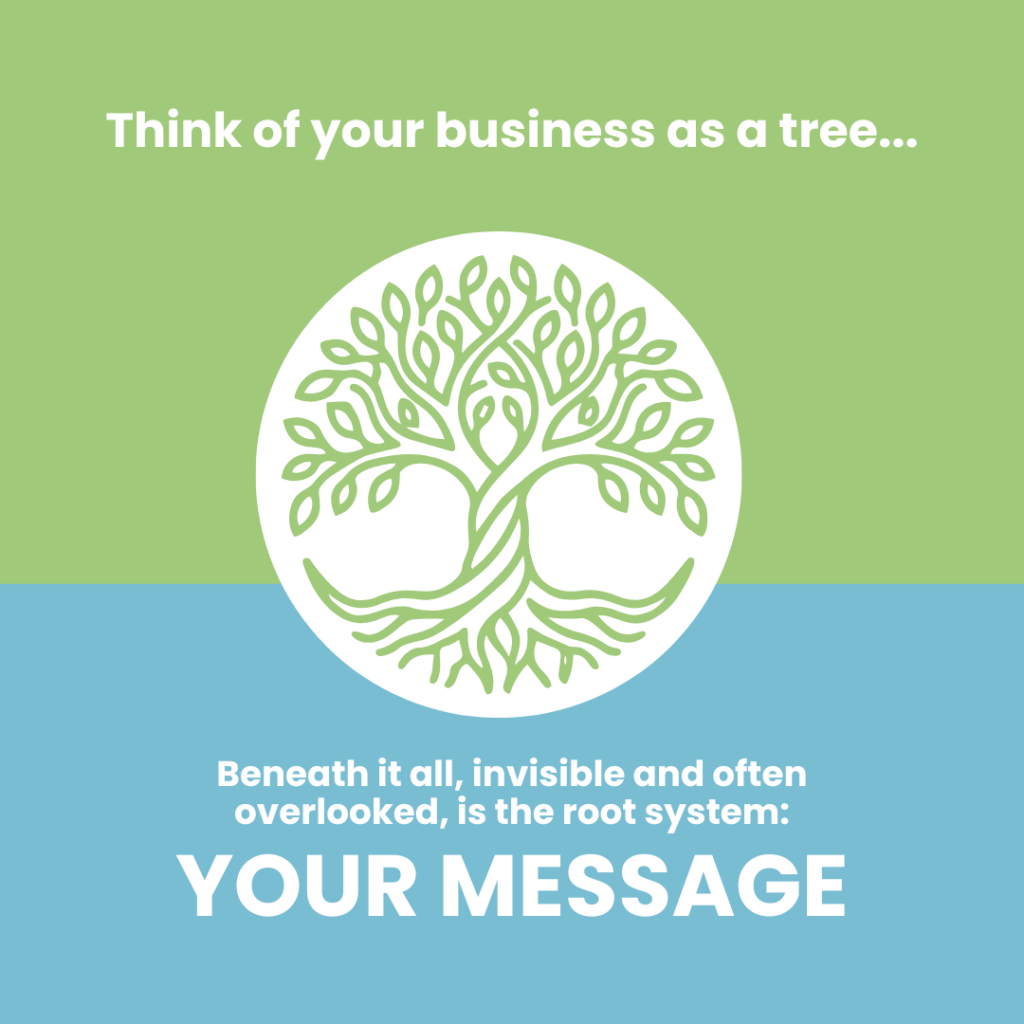
Think of your business as a tree. Your blog posts, social media, proposals, emails, and presentations are the branches and leaves. Beneath it all, invisible and often overlooked, is the root system: your message.
When your message is clear, specific, and aligned to your ideal client, everything above ground flourishes. Content becomes easier to write. Conversations flow. Clients say, "It is like you read my mind."
When the roots are tangled or shallow, even the most polished content withers. You can have a gorgeous website, a consistent posting schedule, and still hear nothing but silence.
Apple understands this.
When Steve Jobs introduced the iPod in 2001, he did not say "5GB MP3 player." He said, "1,000 songs in your pocket." Every competing product on the market could have made the first statement. Only Apple made the second. One describes a storage specification. The other describes a feeling.
That clarity was not an accident. It was a deliberate decision to translate a technical feature into a human experience. Their entire ecosystem, from packaging to advertising to retail stores, grew from that single, clear root.
The same principle applies to your practice.
Want to go deeper on brand messaging strategy? Building a StoryBrand by Donald Miller is a foundational read for service professionals.
The Gap That Is Costing You Clients
There is almost always a gap between how you see your own work and how the market sees it.
You see the depth of your methodology. Your clients see the problem they desperately need solved. You speak the language of your expertise. Your clients speak the language of their frustration.
That gap is exactly where clarity lives. Closing it is the most important work you do before creating any piece of content.
Consider a family law attorney. On her website, she describes her practice this way: "Experienced legal representation in divorce, asset division, and parenting time matters." Clear enough to a colleague. But her potential client is not searching for that. She is typing: "How do I protect my kids if we split up?" or "What happens to my house in a divorce?"
One is the language of a profession. The other is the language of fear at two in the morning. Those two phrases need to meet in her message. Until they do, the right people read her website and keep scrolling, not because they do not need her, but because nothing she wrote made it clear she understood what they were going through.
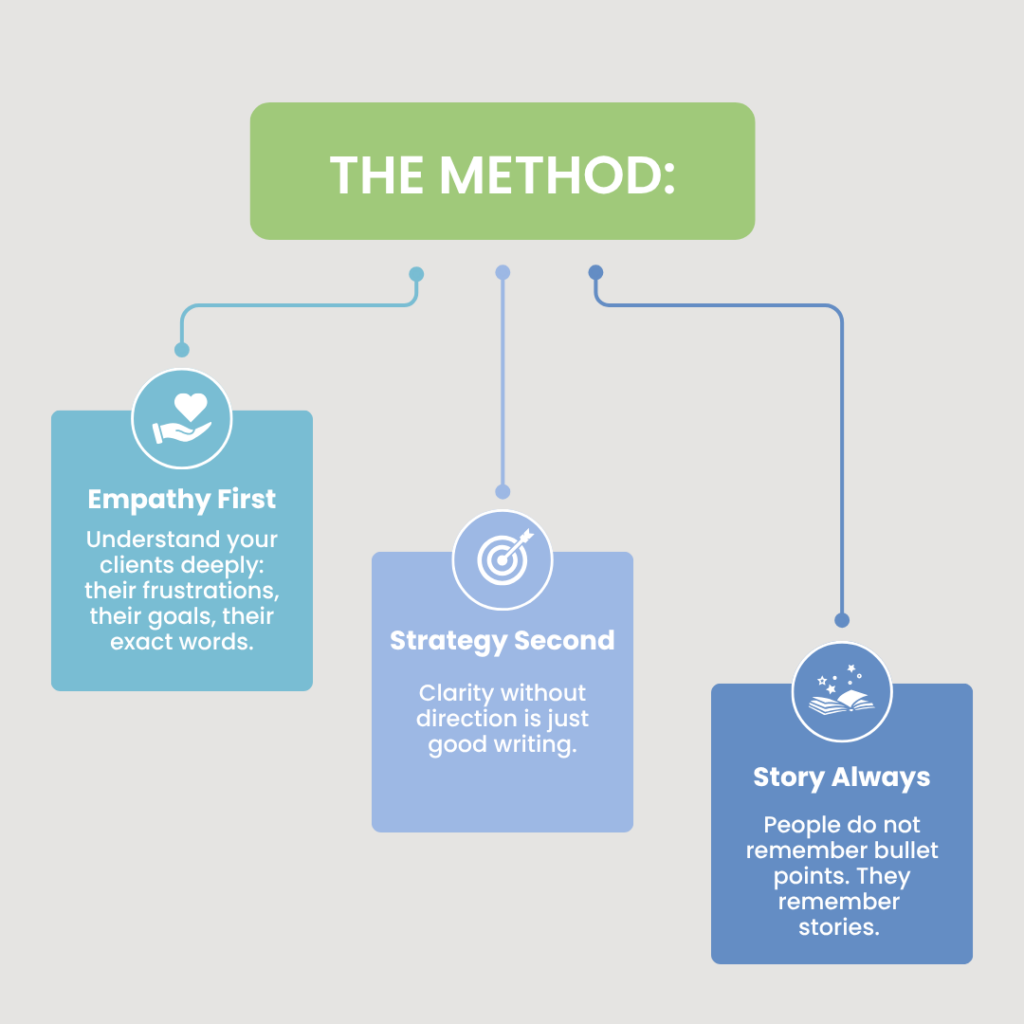
The Method: Empathy First. Strategy Second. Story Always.
Great messaging does not start with tactics. It does not start with a content calendar, a new logo, or a brand refresh. It starts with a rigorous act of empathy.
Understanding your clients. Their challenges. The exact language they use to describe what they need. Then, building a strategy on top of that clarity. Then shape it into a story your clients can see themselves in.
Empathy First
Understand your clients deeply: their frustrations, their goals, their exact words. When you speak their language, your marketing stops feeling like noise and starts feeling like a conversation they have been waiting to have.
The most direct path to empathy is listening. Talk to your best clients. Read their reviews. Notice the exact words they use to describe the problem you solve. Those words belong in your message.
Strategy Second
Clarity without direction is just good writing. Build a strategic foundation that connects your positioning to real business goals. Every marketing decision has a purpose.
This is where positioning becomes critical. In Obviously Awesome, positioning strategist April Dunford defines positioning as "the act of deliberately defining how you are the best at something that a defined market cares a lot about." Her framework helps you identify who you truly serve, what makes you distinct, and the context that makes your value obvious.
Most service professionals skip this step entirely. They describe what they do without explaining why it's the right choice. Positioning is that context. Without it, even strong messaging floats.
Story Always
People do not remember bullet points. They remember stories. Shape your message into a narrative that puts your client at the center and positions you as the trusted guide who helps them win.
The StoryBrand framework by Donald Miller is built on this principle. Your client is the hero. You are the guide. Your job is to help them solve a real problem and reach a specific transformation.
Alignment Across Every Touchpoint
Strategy means nothing if your website says one thing, your content says another, and your sales conversations say something else. Every touchpoint must work together, consistently and confidently.

Brene Brown writes in Daring Greatly: "Vulnerability is the birthplace of love, belonging, joy, courage, empathy, and creativity."
That principle applies directly to your brand. When your message honestly names the struggle your client is living and speaks to it without flinching, you create the kind of connection that builds trust before a single conversation happens.
Think of how Brown shows up across her talks, books, social media, and interviews. The message never changes. The context does. That consistency is what makes her voice authoritative and trustworthy. Your brand works the same way.
How to Tell a Story Your Clients Can See Themselves In
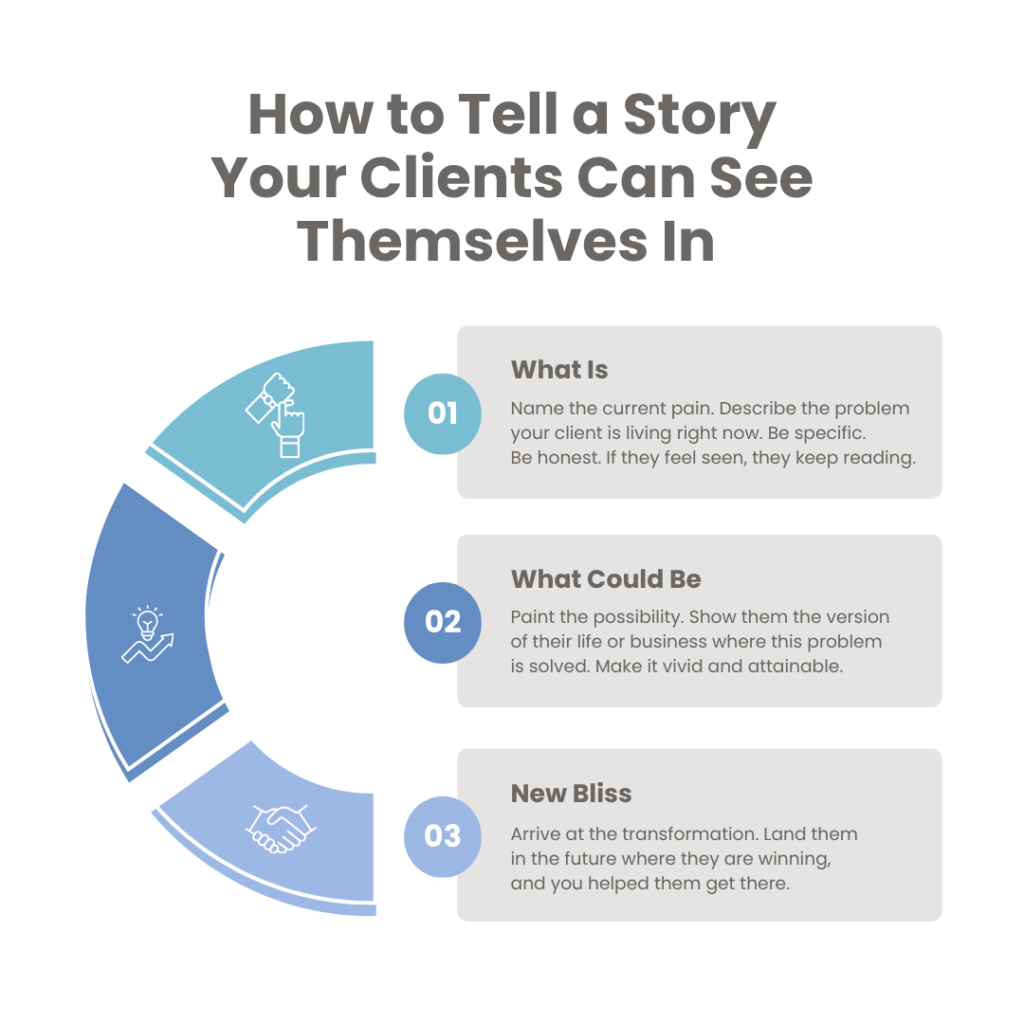
One of the most effective frameworks for clear messaging comes from presentation strategist Nancy Duarte. She describes a narrative structure that moves your audience from the world as it is to the world as it could be.
What Is: Name the current pain. Describe the problem your client is living right now. Be specific. Be honest. If they feel seen, they keep reading.
What Could Be: Paint the possibility. Show them the version of their life or business where this problem is solved. Make it vivid and attainable.
New Bliss: Arrive at the transformation. Land them in the future where they are winning, and you helped them get there.
This is not just a presentation technique. It is a messaging philosophy. When your ideal client reads your website, receives your email, or hears you speak, they should feel this arc. They should see themselves in the What Is, feel the pull of What Could Be, and trust you as the guide who gets them to New Bliss.
Example: A business coach whose message reads "I help overwhelmed entrepreneurs build systems" is doing the work. "You started your business for freedom, not to feel like you never leave the office" pulls someone into a story. That is the difference.
Clarity Turns Expertise Into Demand
When your message is clear, something shifts. Your expertise becomes visible in a way it simply was not before. You stop competing on price and start attracting on alignment.
Clients arrive already convinced. Referrals feel natural. Content practically writes itself because you know exactly who you are speaking to and exactly what they need to hear.
This is what Angelina Millare experienced after shifting her message. She moved away from describing her technology services by features and process, and started speaking to how she works and what it means for the people she serves. The result was immediate. She closed a new high-ticket client in thirty minutes, without a completed website. Shortly after, she had a five-figure week. Her words: "If that is the experience they want to have, it makes me the only choice. Not one of the choices."
That is not a marketing win. That is a messaging win.
In her research with B2B companies, April Dunford found that unclear positioning is one of the primary reasons strong products and services fail to grow. The same is true for service businesses. When your positioning is unclear, clients cannot confidently refer you, choose you, or explain your value to others.

A Note for the Skeptics
"I just need more leads."
"My clients come from referrals anyway."
"I already know who I serve."
We hear this often. Here is what we ask every time:
Can you say, in one sentence, exactly who you serve, what problem you solve, and why you are the right choice, in language your client would use, not language from your industry?
If the answer is a hesitation, a list, or a paragraph, the work begins there. Everything else flows from it.
Three Questions to Test Your Message
Before you write another piece of content, answer these three questions honestly.
- Would your ideal client read your homepage and immediately say, "This is exactly what I need"?
- Does your message describe a transformation, or does it describe a process?
- If a stranger read your LinkedIn bio, would they know who you serve and what problem you solve?
If any answer is a "maybe" or a "sort of," your message needs work. That is not a flaw. It is the next step.
Clear Messaging Is Not a One-Time Fix
Clear messaging is not something you finish once and file away. It is the ongoing practice of staying in alignment with your audience as your business evolves.
"Remember, as your clients, business, and the world evolve, so does your messaging." — Darla Kirchner, Kirchner Marketing
Start by asking yourself: Does every piece of content I create flow from one clear, resonant message?
If the answer is no, you now know where to start.
Book a clarity call and find out exactly where your message is breaking down.
Related Reading
- Building a StoryBrand by Donald Miller
- Resonate by Nancy Duarte
- Obviously Awesome by April Dunford
- Daring Greatly by Brene Brown